
Sinkholes in California? Really? The Big Myth.
Honestly, when most people hear “sinkhole,” their minds probably jump straight to Florida. You know the images: whole cars swallowed, houses disappearing into the earth. It’s a vivid picture. But here in California? Many folks figure we’re too busy worrying about earthquakes and wildfires to even think about the ground opening up. That’s a common misconception. We don’t have the same kind of limestone bedrock that makes Florida so susceptible to dramatic, sudden collapses. Our geology is different.
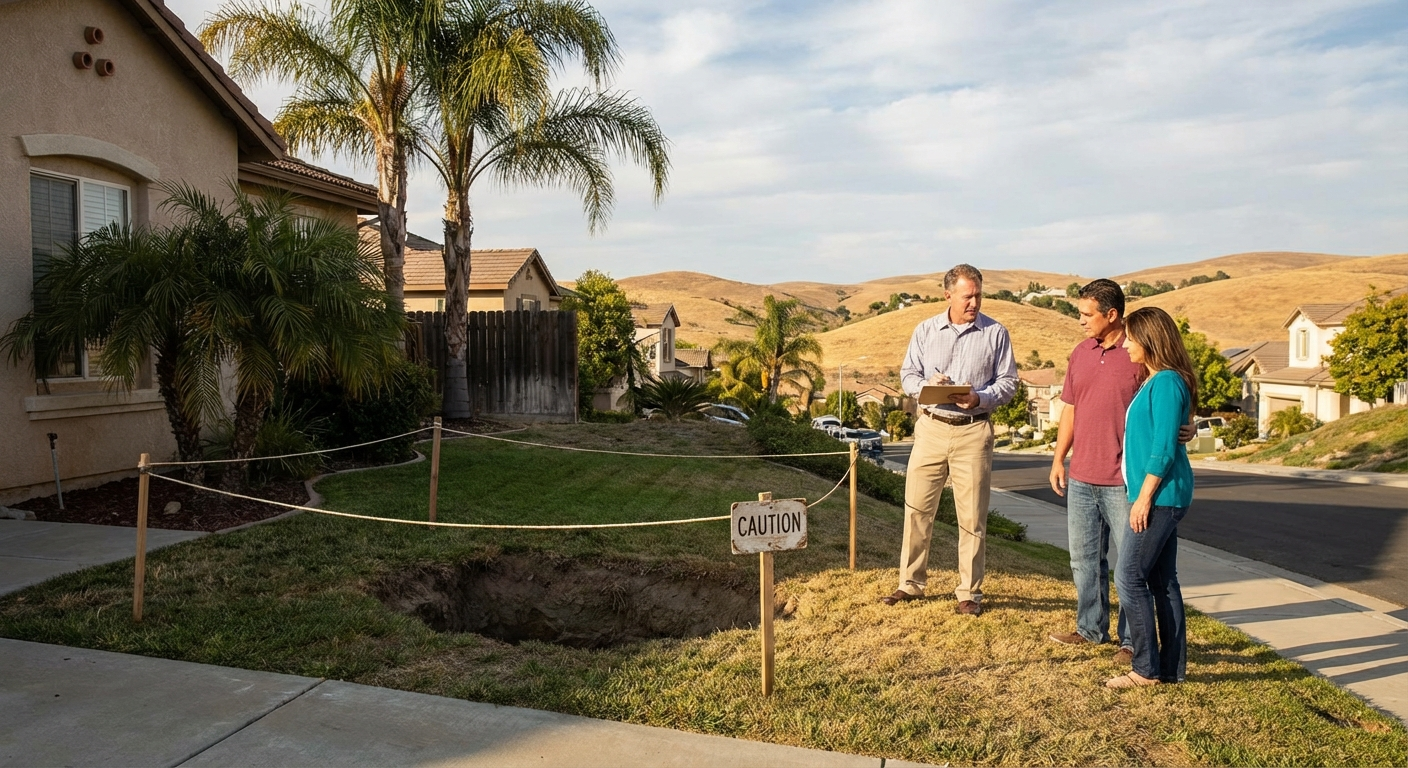
Yet, that doesn’t mean California homeowners are completely immune to ground movement that *feels* a lot like a sinkhole. We’ve got our own quirks. Think about areas with ancient lava tubes, old mining tunnels, or even just rapidly eroding hillsides after heavy rains. Sometimes, a void *can* form beneath a structure. And when that happens, the damage can look terrifyingly similar to what you’d call a sinkhole in another state.
The short answer to “Does my insurance cover this?” is usually no. The real answer, of course, is far more complicated, full of caveats and fine print.
Your Standard Homeowner’s Policy: What It *Doesn’t* Cover
Most California homeowners carry an HO-3 policy. It’s the standard. It protects against a whole list of perils: fire, theft, wind, hail, burst pipes. You know, the usual stuff. But flip through that thick policy document, and you’ll quickly run into a major exclusion: “earth movement.”
This isn’t just about earthquakes. Oh no. The term “earth movement” blankets a wide array of ground-related problems. We’re talking landslides, mudslides, land subsidence – which is a fancy way of saying the ground slowly sinking – and yes, *sinkholes*. If the earth beneath your home shifts, slides, or collapses due to natural forces, your standard policy likely won’t pay for the repairs. It’s a hard truth for many homeowners, especially those living in hillside communities or areas with expansive clay soils.

The ‘Earth Movement’ Exclusion: A Closer Look
Think about it. California sits on some of the most dynamic geology in the world. We have active fault lines running through the state like veins. We have coastal bluffs constantly eroding. We have mountainsides prone to sliding, particularly after a few wet winters saturate the soil. The insurance companies know this. They’ve baked these risks right into the policy language.
So, if your house starts to crack because the ground beneath it is slowly sinking, that’s typically considered “earth movement.” If a sudden void opens up and your driveway disappears, that’s also “earth movement.” It’s a broad category, designed to exclude the very real, very expensive risks associated with living on a moving planet. It doesn’t matter if it was a dramatic, sudden event or a slow, creeping problem. If the ground itself moved, you’re probably out of luck with a basic HO-3 policy.
So, What *Can* You Get? Earthquake Coverage and Endorsements
Okay, so your regular policy probably won’t help if the earth moves. But don’t despair completely. There are options, though they might not be exactly what you’d think of as “sinkhole coverage.”
For most ground movement in California, your primary line of defense is earthquake insurance. Many people think earthquake policies only cover damage from shaking. Not always. Some earthquake policies, particularly those from the California Earthquake Authority (CEA), can offer coverage for land subsidence or liquefaction *if* it’s directly caused by an earthquake. That’s a big “if,” of course. It won’t cover a sinkhole that just appears out of nowhere on a sunny day.
Sometimes, you *can* find specific endorsements – add-ons to your policy – that might offer limited coverage for “sudden ground collapse.” But these are rare, they’re often expensive, and they come with very specific definitions of what constitutes “sudden.” It’s not a blanket fix. And you won’t find State Farm, AAA, or Farmers just handing these out for every property. They’re typically for very specific, often commercial, risks or in areas with known, but rare, geological issues.
Earthquake Insurance: Not Just for Shaking
Let’s talk about the California Earthquake Authority for a moment. Most homeowners get their earthquake policy through the CEA. It’s a state-run program. While its main purpose is to cover damage from seismic activity, its policies *can* extend to cover certain types of land movement. For instance, if an earthquake causes the ground to liquefy and your house sinks, the CEA policy *might* respond. But remember, these policies often come with very high deductibles – sometimes 15% or 20% of your dwelling coverage. That means if your home is insured for $500,000, you might have to pay $75,000 or $100,000 out of pocket before the policy kicks in. Big difference.
Private earthquake insurers also exist, offering different coverages and deductibles. They might have more flexibility, but they’re also often more selective about who they’ll insure, especially in higher-risk areas like the Ventura County hills or parts of the Valley known for liquefaction potential.
Water Damage vs. Earth Movement: A Tricky Line
Here’s where it gets interesting. What if a “sinkhole-like” event happens, but it’s not purely natural earth movement? What if a burst pipe under your house slowly erodes the soil, creating a void that eventually causes a slab to crack or a foundation to drop? This is a common scenario and a point of much contention in insurance claims.
Your standard HO-3 policy *does* cover sudden and accidental water discharge from a pipe. So, if the water causes the damage, even if that damage looks like a mini-sinkhole, there’s a chance it could be covered. The key here is proving causation. Was the ground movement the primary cause, or was the burst pipe the primary cause, leading to the ground movement? Insurance companies will scrutinize this. They’ll send adjusters, engineers, and geologists to figure out exactly what happened. It’s a battle of experts, often.
For most California homeowners, understanding this distinction is absolutely crucial. A slow leak over years that causes subsidence? Probably not covered. A sudden, catastrophic pipe burst that washes away supporting soil? That’s a different story.
The Real California Risks: Landslides and Subsidence
While dramatic sinkholes like those in Florida are rare, California faces far more common and equally destructive ground movement issues. Landslides, for instance, are a constant threat in many hillside communities, especially after a series of atmospheric rivers. Think about the mudslides that have plagued areas like Montecito or the coastal communities in Malibu. These are direct results of saturated soil giving way.
Then there’s subsidence. In parts of the Inland Empire, or even in areas of the Central Valley where groundwater has been heavily pumped, the land can slowly compact and sink. This isn’t a sudden event. It’s a creeping problem that can cause foundations to crack, pipes to break, and roads to buckle.
These are the “sinkhole-like” events California homeowners truly need to worry about. And these are the precise risks that are almost universally excluded by standard home insurance policies. If you live on a hillside, near a canyon, or in an area with known expansive clay soils, you’re living with these risks every day. It’s why getting an expert opinion on your specific property’s risks is so important.
Why Getting the Right Advice Matters – Karl Susman Can Help
Look, navigating the complexities of homeowners insurance in California is not for the faint of heart. Policies aren’t one-size-fits-all. What works for a flat lot in a suburban tract might be completely inadequate for a home perched on a scenic bluff in Palos Verdes. Understanding the nuances of “earth movement” exclusions, the limitations of earthquake policies, and the potential for water-damage claims to intersect with ground movement issues requires real expertise.
That’s where an experienced, local agent like Karl Susman comes in. He and the team at LA Home Insurance Quotes know California’s unique challenges. They can help you understand what your policy *actually* covers, what it doesn’t, and what options might be available to mitigate your specific risks. You need someone who can translate insurance jargon into plain English and guide you through the process. Don’t guess with your biggest asset.
Ready to talk about your home’s unique risks and coverage needs? Get a California home insurance quote today.
The Evolving Insurance Market in California
Now more than ever, the California insurance market is in flux. With the increasing frequency and severity of wildfires, some major insurers have pulled back or stopped writing new policies in certain areas. This makes finding comprehensive coverage – let alone specialized endorsements – even harder. The FAIR Plan, California’s insurer of last resort, has stepped up, but it offers very basic coverage. Meanwhile, Prop 103, while designed to protect consumers, has also created challenges for insurers trying to adapt to rising costs and risks.
This means you can’t just set it and forget it with your home insurance. You need to review your policy regularly, understand any changes, and make sure you’re getting the best possible protection in a constantly changing environment. A good agent isn’t just selling you a policy; they’re your advocate in this shifting landscape.
Don’t wait until disaster strikes to find out what you’re truly covered for. Connect with LA Home Insurance Quotes, CA License #0B75129, for a personalized home insurance quote. Or call us at (877) 411-5200.
Frequently Asked Questions About California Ground Movement Coverage
Does my standard homeowner’s policy cover sinkholes in California?
Generally, no. Most standard HO-3 homeowner’s policies in California contain an “earth movement” exclusion, which includes damage from sinkholes, landslides, and subsidence.
Is earthquake insurance the same as sinkhole coverage?
Not directly. While earthquake insurance (like policies from the California Earthquake Authority) can cover ground movement like liquefaction or subsidence *if* it’s directly caused by an earthquake, it won’t cover a sinkhole or land collapse that occurs independently of seismic activity.
What if a burst pipe causes the ground under my house to collapse?
This is a critical distinction. If a sudden and accidental discharge of water from a pipe is the direct cause of soil erosion and subsequent ground collapse, your standard homeowner’s policy might cover the damage, as water damage from a burst pipe is typically a covered peril. However, the insurance company will investigate thoroughly to determine the primary cause.
Can I get a special endorsement for ground collapse?
It’s rare for residential properties in California. While some specialized endorsements for “sudden ground collapse” might exist, they are not common, can be expensive, and usually have very specific definitions and limitations. It’s best to discuss your property’s specific risks with an experienced agent like Karl Susman.
How do I know if my property is at risk for subsidence or ground movement?
You can research geological maps for your area, look for signs of previous ground movement (like cracks in neighboring foundations or retaining walls), and consult with local geologists or structural engineers. An experienced insurance agent familiar with California’s geography can also help you understand common risks in your specific region.
This article is for informational purposes only and does not constitute financial advice.